Most every leader I talk to right now is hearing the same message: “Use AI to get smarter, support your teams and clients, and get ahead. How? By adopting the tools and moving faster. Now Go, Start!”
I understand the pressure. But I want to offer you a different starting point — one that a consultant and author named Patrick Lencioni made back in 2012, years before the phrase ‘AI agent’ was a common part of our vocabulary.
Lencioni has built his career studying why some organizations thrive and others just survive. In The Advantage, (one of his many books), Lencioni makes a claim that still holds: “The difference between successful and mediocre companies has little to do with how smart they are and everything to do with how healthy they are.”
Imagine that… not tools, talent, or technology. Health.
How I Suggest Updating Lencioni’s Healthy Organization Definition
As AI becomes embedded in organizations, I believe Patrick Lencioni’s work has arguably become more relevant — not less.
Twenty years ago, speaking about organizational health was not on everyone’s mind. Those soft-skills were nice-to-haves, right? Fast forward to today, and discussions about creating and maintaining a healthy culture is becoming an absolute business reality.
Here’s how I compare Lencioni’s thinking with what I’ve learned so far about what a healthy organizational culture must become in the age of AI.
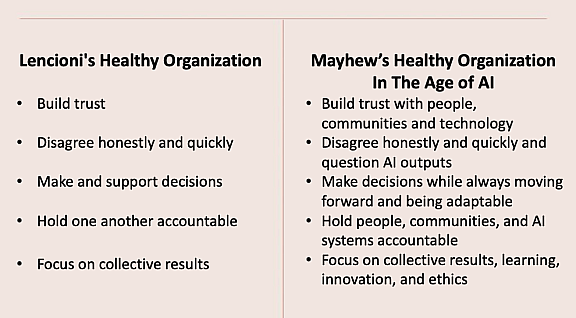
In a healthy culture people must be able to say, “I’m scared” or “I don’t know” and team mates should be willing to step in and say, “Let me help you” and “Let’s have a conversation about this”.
The way I interpret Lencioni’s work today is that one of the greatest assets a company can have is to be healthy. Why? because while strategy, marketing, and technology can all be copied, a healthy organization culture can’t be duplicated. It has to be created, built one step at a time… and over time trust is earned. Even one small crack can begin to drain the culture away.
What I’m Seeing
This isn’t theory. I’m watching it play out in real organizations right now.
I’ve worked with teams that rolled out AI tools but still can’t have an honest conversation about who’s using the tools, who’s using them differently, who’s quietly ignoring them, and why adoption looks completely different from one department to the next… and one person to the next.
I believe the gap isn’t a training problem. It’s a health problem wearing a training costume.
The leaders who help their teams and AI integration succeed aren’t the ones with the best AI policy. They’re the ones willing to ask the harder questions like “Did we include everyone in the development planning of our AI strategy before we began building it” and “Do we trust each other enough to tell the truth about how this is actually going?” If the answers are no, and no, then I’m thinking you need to go back to the drawing board and do some repair. It would be like someone hiring an architect and carpenter to build a home for their family but not talking to their children about what they need, why they need it, how they will use it, and what they might need next year.
Today, I believe a healthy company also needs to excel in six areas Lencioni wasn’t explicitly addressing because they weren’t pressing concerns twenty years ago.
Six Traits of a Healthy Organization for AI Adoption
- Intellectual humility. Intellectual humility is the ability to recognize that yesterday’s experience may not be enough and to stay open to the question, “What else could be true?” It matters in AI adoption because teams need enough confidence and humility to challenge assumptions, learn from new information, and avoid treating either human expertise or AI output as automatically correct.
- Cognitive flexibility and adaptability. Cognitive flexibility and adaptability are the ability to adjust thinking, goals, and behaviours as new information, customer insight, ethical considerations, and AI recommendations emerge. They matter in AI adoption because organizations must be able to experiment, evaluate, and change course quickly without losing sight of their values or purpose.
- Psychological safety. This is the shared belief that people can ask questions, admit confusion, raise concerns, and discuss how AI may affect their work without fear of embarrassment or punishment. Psychological safety matters in AI adoption because employees are more likely to use new tools honestly, surface risks early, and learn together when they feel safe enough to speak openly.
- Critical thinking. This is the discipline of testing information, being aware of our own biases, questioning assumptions, looking for evidence, and asking what may be missing. Critical thinking matters because it pushes us to solve problems with logic rather than emotion and transforms us into a valuable, trusted decision-maker.
- Digital judgment. Digital judgment is the ability to decide when to trust AI, when to challenge it, when to disclose its use, and when human experience must override the tool. It matters in AI adoption because organizations need people who can make informed calls about quality, privacy, intellectual property, security, values, and ethical use.
- Human connection. Human connection is the ability to build trust, show empathy, coach others, persuade thoughtfully, inspire action, and have difficult conversations with care and clarity. It matters in AI adoption because as more cognitive tasks are automated, the human advantage shifts toward the relational work that technology cannot do for us.
Why Smart Alone Isn’t the Advantage in AI Adoption
For years, leaders have chased smart. Smarter strategy. Smarter hires. Smarter systems. Now it’s smarter software.
None of that is wrong. But ‘smart’ on its own is incomplete. I believe smart tells us what’s possible. But healthy tells us whether our team can – and does – use all the people and technical resources we have.
As a corporate trainer and keynote speaker who helps leaders and teams build high-trust and high-performing cultures, I’ve been in enough of the right rooms to see the pattern. The team with the best AI tools isn’t always the team getting the best results from them. The team that’s healthy – the one with trust, clear roles, and the courage to say what’s really going on gets more out of a basic tool than an unhealthy team and workplace culture gets out of the best one on the market.
For example: a team adopts AI-generated reports, but no one agrees who owns the data, who checks accuracy, or whether people are allowed to question the outputs. That would be an example where the risk and stress within an unhealthy workplace feels real.
AI Doesn’t Create Health. But It Does Multiply What’s Already There
Here’s an idea I want you to sit with:
- Healthy team + AI = faster clarity, faster trust, faster decisions. When people already speak honestly with each other, a new tool just gives them more to work with. They test it, argue about it, adjust, and quickly move on together.
- Unhealthy team + AI = faster confusion, faster politics, faster burnout. When people already hide problems, protect turf, or avoid hard conversations, AI doesn’t fix that. It speeds it up. Now the confusion just moves faster but likely stalls the whole project.
AI doesn’t fix a broken team. It shows you the cracks faster than anything else you’ve adopted.
A New Definition of Organizational Health in an Era of AI
There is no doubt that a healthy organization is one where people trust one another enough to challenge assumptions, embrace continuous learning, use AI wisely rather than blindly, adapt quickly to change, and remain united around a common purpose while achieving exceptional results. Notice I have positioned people as the centrepiece, not AI. AI is a tool but people and trust are what makes a team or organization healthy.
Smart isn’t the competitive advantage anymore. Healthy is. And while AI is making intelligence more accessible, what becomes scarce is not information but the human capabilities that enable organizations to use that information effectively.
Before asking, “Which AI tool should we adopt next?” leaders may need to ask, “Are we healthy enough to use it well?”