It’s not uncommon for leadership transformation to begin when someone attends a training workshop, hears a keynote at a conference, or participates in an executive retreat. Those moments can spark real inspiration. But transformation does not happen on its own. Without a deliberate plan for what happens after the event, even though you left with the best of intentions, implementing the ideas and strategies you heard / learned are often quickly crowded out by the pressure of day-to-day routines.
A seed that isn’t planted can not grow — even if it’s a great seed with great potential.
For example, inspired leadership isn’t built in a workshop. It’s built in the repeated, small moments — the pause before you react, the question you ask instead of the instruction you give, the feedback you deliver the same day instead of saving it for a review. None of these moments are difficult on their own. What’s difficult is doing them, day after day, until they become who you are instead of something you’re trying to do or be. Even great leadership is the accumulation of habits we’ve learned and practiced.
Yes, a habit is a routine that is performed regularly. To build a new habit, even when something is exciting and transformative, an existing habit needs to be interrupted and maybe even broken to make room for the new. That’s why a leadership transformation needs more than inspiration. It needs a simple, intentional follow-through plan that helps leaders at all levels translate what they heard into visible daily behaviour and then protect that behaviour long enough for it to become part of how the individual and/or team works.
Ground needs to be dug and disturbed so the seed can be planted.
The 30-day challenge was popularized online by bloggers such as Steve Pavlina in 2005 and by Google engineer Matt Cutts in his 2011 TED talk. Its broader roots are often linked to Maxwell Maltz’s 1960s “21-day rule,” which came from his observations as a plastic surgeon.
The challenge works well because it builds early momentum and helps people experience consistent intrinsic rewards. Over 30 days, repeated action starts to feel familiar, but even then they are likely not yet fully locked in.
A useful comparison (I hope), is curing concrete: it may look solid after a day or two, but it takes about 28 days (almost 30) to reach its standard design strength… and the maturing process can continue slowly for years as long as moisture is present. Another comparison is a young seedling. While it may look healthy and strong at day 30, it may not survive a sudden drought or cold spell.
Taking hold of an idea with great potential is important. That’s why I like to end my training / keynotes by suggesting the group choose one or two things they found inspiring from our time together and to create their own 30-day challenge.
How the 30-Day Challenge and Habit Adoption Tracker Work Together
Assume your team attended training and were inspired. Then they are urged by the trainer to choose one or two initiatives they learned that they believe will make a difference for them. They are also encouraged to adopt the 30-day challenge. The challenge can create momentum… but you as their leader can help that momentum survive by continuing to encourage your team to design and support the environment, reminders, and recovery points around the new behaviour(s) they want to adopt.
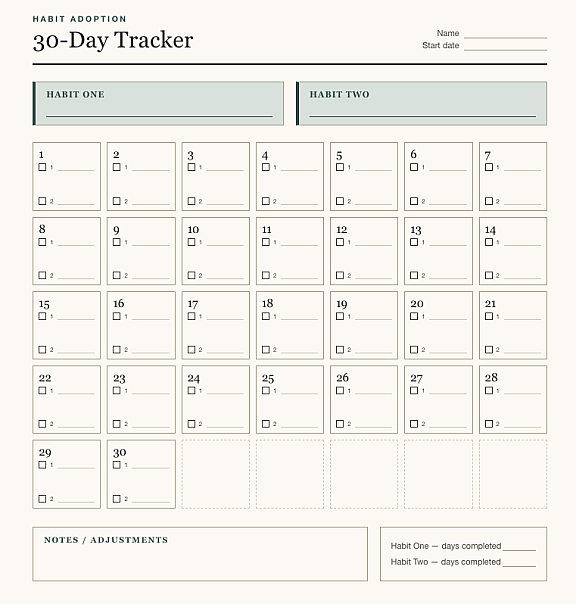
That is exactly the gap the 30-day challenge is designed to track and close. Choose a new routine that you want to become a habit and start doing it every day. Mark your progress / success physically using the habit adoption tracker (see sample below). A habit adoption tracker builds self-awareness, provides visual proof and helps you feel proud of your effort building a new routine. The preference is to keep it somewhere visible where you can watch your daily wins grow. It’s also important to mark your daily success the moment you complete the action, not at the end of the day and especially not at the end of your week. You really do want to take advantage of instant gratification.
If you miss a day, don’t start over. You want to be honest because trust – even in yourself is important. And, if you do miss a day, let that day go with no hard feelings. Just mark it the day as a miss, and move on to tomorrow and take extra care to meet your goal. Nobody is ever perfect. Your goal is evidence of your effort and to feel good… not to ever feel like you let yourself down.
At first, the goal isn’t the 30 days. It is the daily mark on your tracker… it is feeling and seeing your daily wins. Somewhere around day 20 is when the action stops feeling like a task and starts feeling natural — authentic.
Four Ways To Make New Habits Stick
There are four ways leaders can help new habits stick for themselves and for their team, including:
- Start Small: Break complex goals into bite-sized, winnable micro-actions rather than asking people to overhaul everything at once.
- Connect to Meaning: Link everyday tasks back to the core mission and your shared team values / morals so you can clearly connect to the deeper “why” behind the routine.
- Make Cues Obvious: Place visual reminders or value boards in your workspace to prompt the desired actions naturally.
- Track Progress: Monitor incremental milestones, recognize completed routines, and use visible progress to maintain momentum before fatigue sets in.
Many behaviour consultants also suggest habit stacking, which means attaching a new habit to an existing habit or event, such as reviewing risks immediately (the new habit) after a daily stand-up meeting (an existing habit or event). Personally, I am not a fan of this approach because of the new habit needing a crutch. I like to have any new habit find its own rhythm. I find that when the four practices above are implemented well, they lock in the new habit very effectively.
As a leader, another way you can support your team is to walk the talk. How are you modelling the habit adoption process yourself? How are you using the a habit adoption tracker? Can your team see you are using it?
Leaders Watch for Success and Potential Failure
Two common times new habits fail are the first day after the challenge ends and after returning from vacation. In the first instance the new habit didn’t lock-in for some reason; perhaps there were too many missed days. But in the second instance the new habit was going well but the pattern was interrupted before it was fully cured. This is important to know because when we do, as leaders, we can watch for these moments in advance for ourselves and for our team members so the behaviour survives the first break in momentum.
As a leader, if you know one of your team are trying to adopt a new habit, ask them how you can help. Show genuine interest. Do they need mentoring or coaching from you or from someone you can arrange? Encourage them throughout the process. If you are having weekly or bi-weekly one-on-ones with them, (and I really hope you are), make it a point to ask them about their progress. If this new habit is fitting into their long-term career goals… ask them how they see it fit. But, if it doesn’t – if it is just to make them a better person, that is completely fine as well… and frankly may also fit into their long-term career goals.
Start Tomorrow
You don’t need to overhaul how you lead. You need one action, repeated until it’s no longer effortful. Pick the one habit that will make the most difference to you and/or your team. Then, create your tracker and put it somewhere you (and perhaps your team) will see it every day.
Thirty days from now, you won’t just have a full tracker. You’ll have a habit — and a team that’s noticed the difference.
What’s the one action you’d start tomorrow? I’d love to hear.
30-Day Habit Adoption Tracker Template / Sample